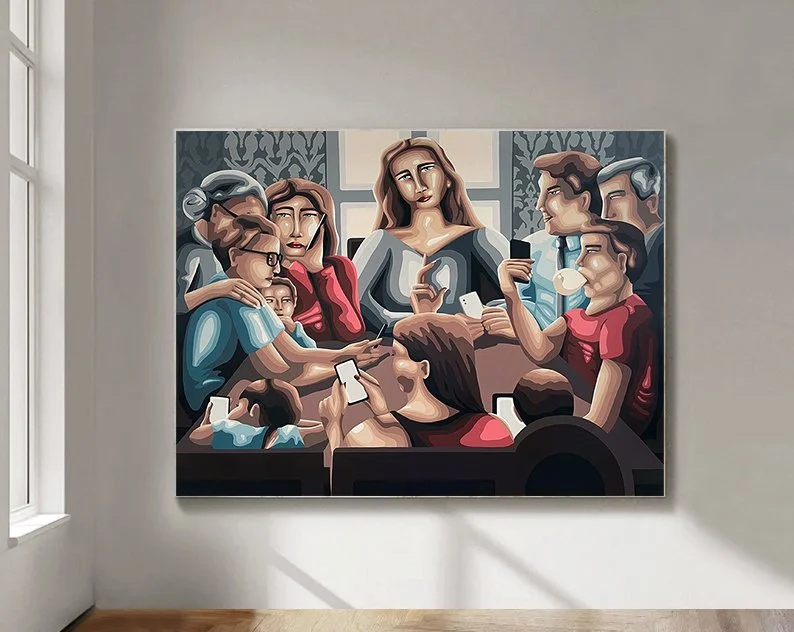
Last Supper 2024
Acrylic on Canvas
48 x 60 inches (121.92 x 152.4cm)

Intoxicated 2024
Acrylic on Canvas
48 x 36 inches (121.92 x 91.44cm)

Under One Roof 2024
Acrylic on Canvas
48 x 36 inches (121.92 x 91.44cm)


No Pockets in your Last Shirt 2025
Concrete Sculpture
24 x 30 x 15 inches (60.96cm x 50.8cm x 38.10 cm)

Sleepover 2023
Acrylic on Canvas
48 x 36 inches (121.92 x 91.44cm)


Shut 2025
Concrete Sculpture
13 x 14 x 5 inches (33.02 x 35.56 x 12.7cm)

After The Party 2024
Acrylic on Canvas
24 x 36 inches (60.9 x 91.4cm)

Other Half 2024
Acrylic on Canvas
40 x 30 inches (101.6 x 76.2cm)

Paramour 2024
Acrylic on Canvas
40 x 30 inches (101.6 x 76.2cm)
Suburbia looks at the space between the life that is presented and the life that is lived.
The series developed from van Alphen’s observations of affluent American suburban life: its architecture, rituals, social codes, expectations, and carefully maintained appearances. Beneath the language of comfort and success lies another landscape—one shaped by loneliness, desire, competition, intimacy, secrecy, and the need to belong.
The suburban home becomes more than a setting. It becomes a psychological structure.
In works including Last Supper, Intoxicated, Under One Roof, Sleepover, After the Party, Other Half, and Paramour, domestic and social situations become moments in which the distance between public identity and private experience begins to show. The paintings ask what happens behind the image of an orderly life and what people reveal when the performance of normality begins to fracture.
The sculptures No Pockets in Your Last Shirt and Shut extend this investigation into material form. Their concrete bodies introduce permanence and weight into a series concerned with the accumulation of possessions, status, and appearances. The material itself becomes a counterpoint to the fleeting nature of the lives and values it represents.
There is also a personal dimension to the series. As someone who moved between cultures and entered American society from the position of an outsider, van Alphen approaches suburbia as both participant and observer. That distance allows familiar social behaviors to become visible as constructed rituals.
Suburbia is therefore not simply a critique of suburban life. It is an examination of the human desire to be accepted, to appear successful, to construct an identity, and to protect the private self behind the structures we build around it.
The polished surface is only the beginning. The work asks what happens when we look behind it.