
American Still Life 2025
Acrylic on Canvas
30 x 24 inches (76.2 x 60.96 cm)

Guerra Americana 2025
Acrylic on Canvas
48 x 36 inches (121.92 x 91.44cm)

Liminal 2026
Acrylics on canvas
24 x 30 inches (60.96cm × 76.2cm)

The Many Faces of Liam Conejo Ramos 2026
Acrylics on canvas
24 x 30 inches (60.96cm × 76.2cm)
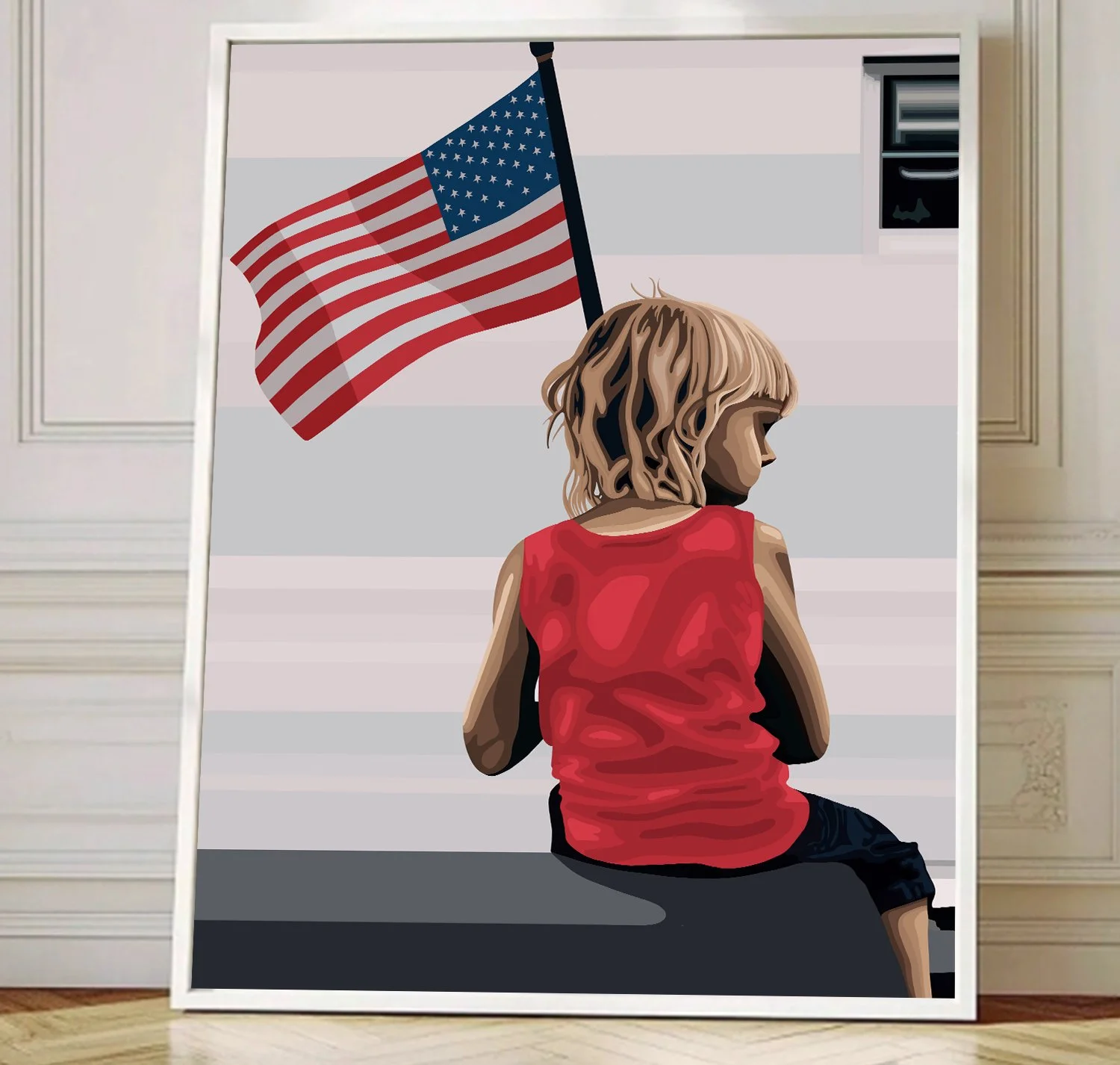
Americana 2026
Giclée Print on Paper
20 × 26.6 inches (50.8 × 67.59cm)
Edition of 10
Signed and Numbered

She 2026
Acrylic on Canvas
30 x 40 inches (76.2 x 101.6 cm)

Conglomerates 2025
Acrylic on Canvas
30 x 40 inches (76.2 x 101.6 cm)
Americana approaches America not simply as a geographical place, but as an idea, an accumulation of images, myths, contradictions, aspirations, and histories. Nina looks at American culture from a particularly complex position: that of an artist born and raised in the Netherlands who has lived in New York since 2001. Her perspective is simultaneously intimate and observational. She participates in American life while retaining the ability to look at its symbols with the eyes of someone who arrived from elsewhere.
This position creates a productive distance within the work. The familiar becomes strange, and the ordinary becomes worthy of scrutiny. Nina's Americana is not an uncomplicated celebration of American identity. Instead, it considers the space between the promise of an ideal and the lived complexity of the society that attempts to embody it. The works become observations of a culture constantly negotiating its own image.
The collection is particularly concerned with the mythology of the American self: independence, freedom, prosperity, individualism, and the pursuit of a better life. These ideals carry enormous cultural power, but they also create expectations. What happens when the promised version of life does not correspond with lived experience? What happens when freedom exists alongside fear, abundance alongside inequality, or confidence alongside profound uncertainty?
Nina's figurative language allows these contradictions to remain embodied rather than theoretical. Her people become carriers of cultural narratives. Their bodies, expressions, surroundings, and relationships suggest the psychological effects of the world they inhabit. The individual and the national imagination begin to overlap: the portrait becomes a portrait of a culture.
This inquiry has become increasingly urgent within van Nina's practice. Her recent writing around Guerra Americana connects contemporary American life to historical memory, conflict, and the responsibility of the artist to bear witness. Her own family history in Europe, including grandparents who lived through the Second World War, informs her sensitivity to the consequences of political and social division.
Americana, then, is ultimately less about defining America than questioning the images through which America defines itself. Van Alphen does not position herself as an outsider passing judgment, nor as an insider offering reassurance. Instead, she occupies the complicated middle ground of the observer-participant. Her America is lived, remembered, questioned, and continually reconstructed, a nation seen through the eyes of someone who understands that belonging and distance can exist simultaneously.